| How would you like to view this page? | ||
|
Jump to
Note: the Estonia & Lithuania Guides now have theirs own pages! See Also:
|
(The guides below are based on the following visits: Riga: Oct 2000 & April 2003) |  |
| Introduction I’ve been lucky enough to have been to the Baltics on four separate occasions so far, and I dearly love this part of the world. However I cannot claim to be an expert in this field, so what follows is merely some suggestions that may give some alternative ideas about what to do, see and drink. Aside from a wide amount of expert knowledge amongst the Tartan Army at large, and the conventional guide books such as Lonely Planet, another excellent source of information for this part of the world exists in the In Your Pocket Guides. |
 |
|
| Latvia is the central Baltic nation, and is the shortest from top to bottom. It is often assumed to sit in the middle of the other two in terms of stereotypes – Estonia and Lithuania form the extremes. One thing to note is the high Russian population – around 47% of the population are ethnically Russian, and indeed they form a majority in the two biggest cities: Riga and Daugavapils. Most of this is the result of the massive population displacements the nation suffered under Soviet rule (visit Riga’s moving occupation museum for a better understanding). As a result, Latvia itself is very exacting with citizenship, and language and history tests have to be passed before it is granted. This has all led to a lot of anti-Russian racism, a backlash of sorts, and a fair bit of tension: you are very unlikely to experience this (unless you are close to Latvians or Russians, or speak either language). |
|
|
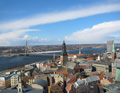
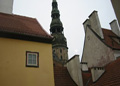
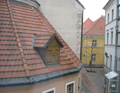
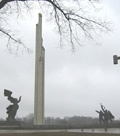
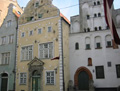
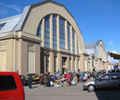
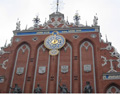
| Riga is my favourite of the Baltic capitals as it is just a functional big city with a very pretty centre. By that, I mean it doesn’t care if you are a tourist or not, it just gets on with being what it is, with or without you (this is hard to explain, but I like it!). The action is pretty much centred around the old town, known as Vecriga. Full of narrow, cobbled lanes and red brick churches and buildings, Riga has maintained many links with it’s Hanseatic past. The city celebrated it’s 800th anniversary in 2001, and was European Capital of Culture to celebrate. There are many sights to see, some of which I’ve listed below, and a good way to get your bearing is to take the minibus tour of the city from in front of the Rifleman’s statue (most hotels and the tourist office in the House of the Blackheads has info on this). The Hotel Konventa Seta is very highly recommended – I’ve stayed in all sorts of rooms there on my three visits (standard double, junior suite and suite). All are very spacious (obviously, they get bigger as you go up), and the cleaners are stunning. Radi un Dragi (Friends and Relatives) is also highly recommended – it’s right opposite Dickens Pub. For all mod-cons, use the Radisson SAS – just bear in mind that it’s a long way across the river! |
|
|
|
|
|
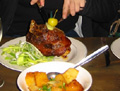
As well as the Skyline Bar mentioned above (which is more of a sight anyway – not one for a session!), here are a few more you may wish to consider:
|
|
|
Jurmala Just down the coast from Riga, and practically conjoined to the Riga metropolis, is the gorgeous resort of Jurmala, home to many a retired Soviet colonel. Jurmala is actually a string of several towns joined together along the beach – Majori seems to be where it’s mostly at, and has a Disney-esque main street lined with brightly coloured houses. Head down to the wide golden sandy beach, where there are plenty of facilities, including an amusement park, several bars on the sand itself and changing facilities. Local trains leave regularly from Riga’s main station (just to the south-east of Vecriga) – these are the biggest trains you will ever see! Get off at Majori, where you too can experience the worst Gents toilet I have ever seen – if it hadn’t been for the gnarled old woman charging 15p a go I would have been back in with a camera just to prove it to you! We went on a warm (for the Baltics) September day – you may want to give it a miss if you’re there in February! |
||
Text Links: [HOME] [BASICS] [INFO & NEWS] [TRAVEL] [INTERACTIVE] [MEMORIES] [FUN] [NETLEY GUIDE] [TARTAN ARMY] [SITE MAP]
Copyright notice:
All photographs on this site are the property of individual members of
the Netley Abbey Tartan Army unless otherwise stated. The copyright of
these images remains with the individual possessing the photographic negatives,
and permission should ideally be sought before copying them. We are keen
to prevent anyone from making financial gain from our copyrighted images,
or bringing the reputation of the Netley Abbey Tartan Army into disrepute
(as we are more than capable of doing this ourselves).
If anyone does wish to use these images and
would like express written consent to do so, please e-mail Paul Allison
using via the contact page.
© Netley Abbey Tartan Army, 2001-2008
(and beyond...)